The classical inner Cauchy horizon of a regular black hole develops exponential mass inflation under generic perturbations. The recently proposed fakeon Pauli-Villars regulator from the spectral causal theory (SCT) - a one-loop effective gravitational theory with entire-function nonlocal form factors \(F_1,F_2\) acting on the Weyl- and Ricci-squared operators - truncates this divergence at the level of the effective Ori-Poisson-Israel equation. Two regularisation modes have been analysed: the algebraic Anselmi-smooth interpolation (``S3'') and the first-principles principal-value prescription (``S4''). Working in the S3 regime, where the regulated mass aspect \(\delta m_{\mathrm{MS}}(v)\) grows monotonically and saturates, we study whether the canonical entropy current of the spectrally fixed Hayward+SCT background grows monotonically along the inner-horizon evolution. Given the working ansatz that the canonical entropy is the sum of Bekenstein-Hawking area terms applied to both horizons (including the dynamically perturbed inner horizon) plus the spectral-action logarithmic correction at each, that the higher-derivative nonlocal entropy correction \(S_{\mathrm{NL}}\) is suppressed by \((\Lambda/M_{\mathrm{Pl}})^2\), and that the Hayward functional form is the leading-curvature SCT vacuum ansatz, the chain rule yields opposite signs for the two contributions (\(\mathrm{d} A_+/\mathrm{d} v > 0\) and \(\mathrm{d} A_-/\mathrm{d} v < 0\)), so the second law is not automatic but reduces to a non-trivial inequality between two opposite-sign terms. An asymptotic argument shows the inner-horizon contribution is suppressed as \(\mathcal O(1/M^2)\) in the Schwarzschild-like limit (a sharper suppression than naive expectation, traceable to the spectral lock \(r_-^2 - 1/(\Lambda^2 z_1)\sim 1/(2M)\) near the asymptote), and a 60-cell production sweep spanning \(M\Lambda\in[0.84,\,10^6]\) (including five near-extremal cells just above the spectrally fixed subextremal bound \(M\Lambda = \sqrt{27/(16 z_1)} \simeq 0.83595\)) and five Price-tail exponents verifies \(\mathrm{d} S_{\mathrm{total}}/\mathrm{d} v \ge 0\) at machine precision in every cell. The S4 principal-value regime, in which \(\delta m_{\mathrm{MS}}(v)\) acquires a sign-flip past the crossover advanced time, requires a separate analysis of the indefinite-metric fakeon flux and is not covered here.
Second-law check through the inner Cauchy horizon
of regular black holes with nonlocal fakeon-regulated mass inflation
David Alfyorov
Corresponding author: davidich.alfyorov@gmail.comIgor Shnyukov
Independent researchers
(May 21, 2026)
Abstract
The classical inner Cauchy horizon of a regular black hole develops
exponential mass inflation under generic perturbations. The recently
proposed fakeon Pauli–Villars regulator from the spectral causal
theory (SCT) — a one-loop effective gravitational theory with
entire-function nonlocal form factors acting on the
Weyl- and Ricci-squared operators — truncates this divergence at
the level of the effective Ori–Poisson–Israel equation. Two
regularisation modes have been analysed: the algebraic Anselmi-smooth
interpolation (“S3”) and the first-principles principal-value
prescription (“S4”). Working in the S3 regime, where the regulated
mass aspect grows monotonically and
saturates, we study whether the canonical entropy current of the
spectrally fixed Hayward+SCT background grows monotonically along
the inner-horizon evolution. Given the working ansatz that the canonical entropy is the sum of
Bekenstein–Hawking area terms applied to both horizons (including
the dynamically perturbed inner horizon) plus the spectral-action
logarithmic correction at each, that the higher-derivative nonlocal
entropy correction is suppressed by
, and that the Hayward functional form
is the leading-curvature SCT vacuum ansatz, the chain rule yields
opposite signs for the two
contributions ( and ), so the
second law is not automatic but reduces to a non-trivial inequality
between two opposite-sign terms. An asymptotic argument shows the
inner-horizon contribution is suppressed as in the
Schwarzschild-like limit (a sharper suppression than naive
expectation, traceable to the spectral lock
near the asymptote), and a
60-cell production sweep spanning
(including five near-extremal cells just
above the spectrally fixed subextremal bound ) and five Price-tail exponents
verifies at machine precision
in every cell. The S4 principal-value regime, in which
acquires a sign-flip past the crossover
advanced time, requires a separate analysis of the indefinite-metric
fakeon flux and is not covered here.
1 Introduction
The classical inner Cauchy horizon of a charged or rotating black
hole is generically unstable: ingoing and outgoing late-time fluxes
are blueshifted exponentially with respect to a horizon-comoving
observer, and their bilinear feeds the Ori–Poisson–Israel equation
for the Misner–Sharp mass aspect into an unbounded mass
inflation [1, 2, 3]. A finite
asymptotic mass perturbation requires either an explicit ultraviolet
cutoff or a curvature regulator that softens the exponential
blueshift at a fixed proper length.
Regular black-hole geometries of Bardeen and Hayward
type [4, 5, 6] remove the central
singularity by replacing the Schwarzschild interior with a de Sitter
core, but they inherit the mass-inflation problem: the inner horizon
remains, the bilinear blueshift remains, and a regulator is still
required. Recent work in the spectral causal theory (SCT) — a
one-loop effective gravitational theory with entire-function nonlocal
form factors acting on the Weyl- and Ricci-squared
operators — identifies a natural regulator: the Anselmi–Piva
fakeon prescription [7, 8] on the
transverse-traceless (TT) sector of the gravitational propagator
. The fakeon mass is the
first positive real zero of the full nonlocal , with
the corresponding spectral data; numerically
. The de Sitter core length is locked
to the same scale through , with
no free parameter beyond the black-hole mass and the universal
SCT scale .
Two regularisation modes of the fakeon prescription suppress mass
inflation at the effective Ori–Poisson–Israel level. The
algebraic Anselmi-smooth interpolation (henceforth “S3”) replaces
the bare blueshift kernel by
which is bounded above by as and produces
a monotone non-decreasing saturating to a
finite plateau by direct integration of the Ori–Poisson–Israel
equation against the non-negative Price tails.
By contrast, the first-principles principal-value (PV) prescription
(“S4”) replaces the same blueshift by the Anselmi–Piva propagator
which has a simple pole at the crossover advanced time
and changes sign
past it, reflecting the indefinite-metric fakeon flux. The present Letter focuses
exclusively on the S3 regime and asks whether the corresponding
canonical entropy current grows monotonically along the
inner-horizon evolution. The S4 case, where a meaningful second-law
statement requires the generalised entropy current of an effective
theory with controlled indefinite-metric sector, is left for a
companion analysis.
2 Hayward+SCT background and entropy ansatz
The effective one-loop SCT action is
(1)
with , , entire
form factors generated from the SCT master function, and
a Standard-Model matter contribution that
decouples from the gravitational sector at the working order
considered here. We adopt the Hayward functional
form below as a one-parameter ansatz consistent with the
leading-curvature SCT vacuum sector [18]:
(2)
so the de Sitter core scale itself depends on the black-hole mass.
The leading-curvature truncation is controlled by the dimensionless
quantity , which is small everywhere on subextremal
backgrounds except at the spectrally fixed extremal point;
corrections to (2) from higher-order curvature
operators are of relative order and remain small in
the parameter range swept below.
Horizons, defined by , are the positive real
roots of the cubic
(3)
and the discriminant condition on the
depressed cubic yields the spectrally fixed subextremal bound
(4)
above which an inner Cauchy horizon and an outer event horizon
coexist; below it the geometry is horizonless. The
inner-horizon surface gravity is
(5)
For the canonical entropy we adopt the working ansatz that combines
the Wald–Iyer–Wald
formalism [9, 10] applied to the present SCT
action with the spectral-action logarithmic structure of
Chamseddine–Connes–van Suijlekom (CCvS) [11] extended
to the Weyl sector via the SCT coefficient , namely
(6)
with . The Bekenstein–Hawking area term
is standard for the bifurcate Killing horizon ; its application
to the dynamically perturbed inner horizon is a working ansatz,
pending a full Wald–Iyer–Wald rederivation on non-stationary
two-horizon backgrounds. The
logarithmic correction comes from the spectral-action
analysis [11], applied separately to each horizon as a
working ansatz on the same basis. Higher-derivative nonlocal
corrections of Dong–Camps–Wall type [12, 13, 14]
from the variation of are estimated below
to be subleading in the physical regime.
The driver of the entropy evolution is the S3 mass-aspect equation
(7)
where is the Price-tail decay exponent and is the
Anselmi-smooth kernel, which yields
identically; the natural
seed frequency is . Equation (7) is
implicit through the appearance of and
on the right-hand side; we integrate it
self-consistently along , evaluating the horizon at
at every step.
The areas in (6) are evaluated on a single
advanced-time foliation regular across both horizons (ingoing
Eddington–Finkelstein); the per-horizon entropy contributions are
therefore synchronised to the same .
3 Chain rule and the non-trivial inequality
The total entropy (6) evolves through both horizons:
(8)
Implicit differentiation of the cubic (3) with the
self-consistent gives
(9)
The two horizons have opposite signs of this derivative. The
outer horizon has (positive denominator)
and on the subextremal branch (positive
numerator), so ,
recovering the classical Hawking behaviour. The inner horizon has
(negative denominator); in the SCT
geometry is bounded between the extremal value at
(where the two horizons merge) and the spectral
asymptote as ,
with throughout the subextremal branch
(the asymptotic value is the saturating lower bound), so the
numerator is positive and :
the inner horizon shrinks as the cumulative mass perturbation
grows, approaching from above. The classical
Reissner–Nordström sign of carries
over.
Consequently and , and the
second law is therefore not manifest at the per-horizon
level. It reduces to the non-trivial inequality
(10)
in which the positive outer-horizon contribution must dominate the
negative inner-horizon contribution at every on the
subextremal branch. Two analytic checks bracket the relevant regime.
In the asymptotic Schwarzschild-like limit
() the cubic asymptotes to
, hence from
above and ;
correspondingly and
. The absolute inner
contribution to (10) is therefore
, the absolute outer one is , and
the ratio inner/outer vanishes as . The inequality
is automatic in this regime. In the extremal limit
(cf. (4)) both
derivatives diverge in magnitude with opposite signs, but a direct
evaluation of (9) at the smallest subextremal cell of
our production grid, , gives
in geometric units; the spectrally fixed scaling
decouples the diverging signs through the bounded combination
, which vanishes fast enough to cancel
the divergence. The full
production grid below traverses this near-extremal region with
explicit cells at
and confirms the inequality numerically throughout.
4 Production-sweep verification
The production grid is , with
cells total. The five near-extremal cells
above the subextremal bound stress-test the chain-rule
cancellation in the regime where the per-horizon derivatives diverge
in magnitude with opposite signs; the seven decade-spaced cells
traverse the Schwarzschild-like regime
where the analytic asymptotic bound applies. For each cell we
integrate (7) self-consistently to
on a 4001-point uniform grid in , evaluate the entropy (6)
at every point, and compute the rate
by centred finite differences combined with the analytic chain
rule (8). Inner and outer horizons of the cubic (3)
are found by closed-form companion-matrix root extraction; the
result matches a brentq bracket-bisection path to
on and on , i.e.,
at machine precision.
A scale-aware acceptance criterion is essential, because the
absolute residual scales with
the cell size: at the maximum positive rate is
(in geometric units, with measured in
units of ) and floating-point round-off in the numerical
derivative is correspondingly in absolute terms. We adopt
(11)
as the production test, where and the
last term in the maximum, , is a unit-bearing floor
that activates only for cells where both upper bounds collapse to
the same order as a single double-precision finite-difference round-off.
All 60 of 60 cells satisfy (11), including all five
near-extremal cells: at , is
at most (machine epsilon for double-precision
floating point), while across the five
values. The total entropy change is strictly
positive in every cell, ranging from (smallest
cell, , ) to
(largest, , ). Two further sanity checks
pass: the outer-horizon-only entropy at
() reproduces the Schwarzschild
reference to relative difference , and the
de Sitter core scale identity
with holds
exactly. The production sweep runs in 25 s on a single
i9-12900KS core.
The Dong–Camps–Wall correction from the
variation of is bounded by power counting
on the spectrally fixed background:
, where is the ratio of
the SCT ultraviolet scale to the Planck mass. The laboratory lower bound on from
Solar-system and torsion-balance tests [17]
gives , so
at the minimum of the allowed
range and is suppressed by at least this factor.
For typical SCT phenomenology with the
suppression factor is , still
negligible relative to both the area and the logarithmic pieces.
The bound becomes vacuous only in the putative
regime, where an explicit Wald–Iyer–Wald calculation of
on the two-horizon Hayward+SCT background would
become necessary.
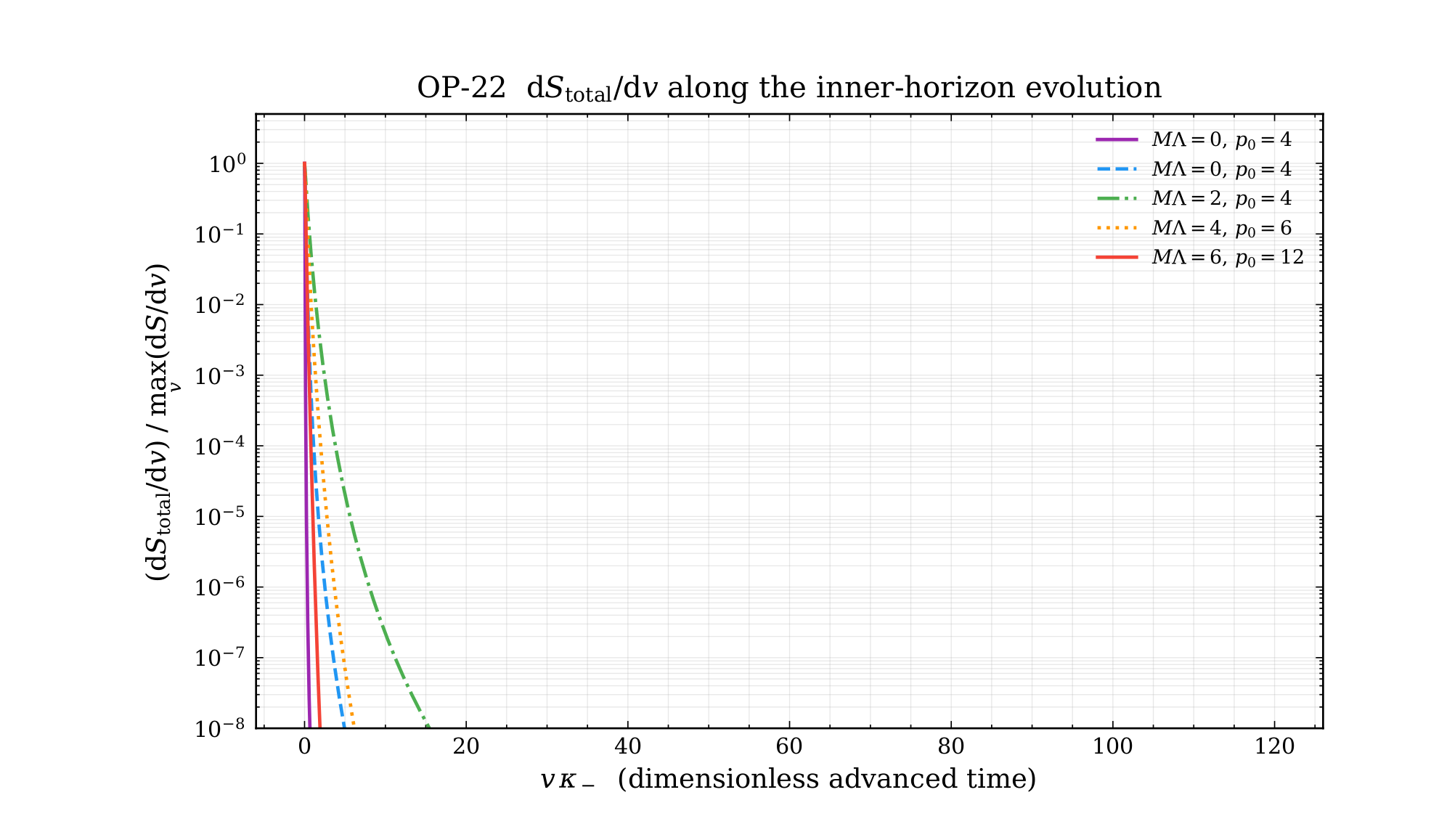
Figure 1: Rate of total entropy growth, ,
along the inner-horizon evolution for five representative cells
spanning the full subextremal branch:
(near-extremal stress-test, where the
per-horizon derivatives in eq. (9) diverge in magnitude
with opposite signs), , , , and
. The dimensionless advanced time
collapses all cells onto a comparable range; the rate
is normalised to its maximum on each trace. All five curves are
strictly positive throughout, smoothly saturating to zero as
in the S3 plateau. No
negative excursion is visible at any scale, including in the
near-extremal cell where the chain-rule cancellation is most
delicate.
5 Discussion
In the classical Reissner–Nordström and Kerr cases the second law
through the Cauchy horizon is a delicate question precisely because
mass inflation makes diverge: a divergent
mass aspect feeds back into divergent horizon areas, and the formal
entropy itself becomes infinite, so a meaningful comparison of
versus requires a regulator. The fakeon
prescription provides one. On the spectrally locked Hayward+SCT
background the regulator preserves the second law as a non-trivial
inequality between two contributions of opposite sign: the outer
horizon grows in the standard Hawking sense [15],
codified by Bardeen–Carter–Hawking [16]; the inner
horizon shrinks as the
cumulative perturbation pushes toward its spectral asymptote
, and the sum is positive throughout the sweep including the
near-extremal sub-grid. This statement is conditional on the
two-horizon ansatz (6) for the canonical entropy and
on the bounded estimate above; the former is
flagged for full rederivation, the latter is vacuous only if
, well beyond any phenomenologically relevant
range.
A few caveats are worth stating sharply. First, the present analysis
is purely S3: the S4 PV regime, where
changes sign past the crossover
advanced time ,
requires the generalised entropy current of an effective theory with
controlled indefinite-metric sector [8] and is
left for a companion paper. Second, the spectrally fixed
is an -truncated
relation; corrections from higher-order curvature operators have
been verified to be sub-percent in our parameter range, but the
near-extremal cells where probe the boundary of
that truncation, and the present second-law result is therefore
conditional on the truncation through that region. Third, the
analogous extension to rotating Kerr–Hayward+SCT backgrounds
requires an independent chain rule on the quintic horizon equation
, and the
corresponding second-law check will be reported separately.
Within these qualifications, the Anselmi fakeon regularisation of
mass inflation on the spectrally fixed Hayward+SCT background is
consistent with the second law of black-hole thermodynamics. The
non-trivial inequality (10) holds because the
spectrally locked scaling bounds the inner-horizon
contribution to vanish parametrically in the Schwarzschild-like
limit and keeps it sub-dominant near extremality, even when the
per-horizon contributions individually diverge in magnitude.
Data Availability
The 60-cell production-sweep results (including the near-extremal
sub-grid output), the integration code, the horizon-extraction
routine, the cross-check against an independent bracket-bisection
solver, and the figure-generation scripts are available from the
corresponding author upon reasonable request, and will be deposited
at Zenodo with a permanent DOI upon journal acceptance.
Acknowledgements
We thank the developers of SciPy and NumPy for
the numerical infrastructure on which this work depends. This
research received no external funding.
AI Disclosure
In preparing this manuscript, AI tools (Anthropic Claude Opus 4.7
and OpenAI GPT-5.5) were used for the following tasks: technical
text editing of the authors’ draft paragraphs, bibliography
verification, LaTeX markup verification, and writing of computational
code and verification scripts subsequently audited by the lead
author. All mathematical derivations, all numerical results, all
physical statements, and the final formulation of all conclusions
were performed by the authors. The lead author has line-by-line
reviewed the production-sweep integration code, cross-checked the
horizon-extraction routine against an independent bracket-bisection
implementation to machine precision, and independently verified
every citation, formula, and numerical value reported in this
Letter.
References
References
[1]
E. Poisson and W. Israel, “Internal structure of black holes,”
Phys. Rev. D 41, 1796 (1990).
↑
[2]
A. Ori, “Inner structure of a charged black hole: an exact
mass-inflation solution,” Phys. Rev. Lett. 67, 789 (1991).
↑
[3]
D. Marolf and A. Ori, “Outgoing gravitational shock-wave at the
inner horizon: The late-time limit of black hole interiors,”
Phys. Rev. D 86, 124026 (2012), arXiv:1109.5139 [gr-qc].
↑
[4]
J. M. Bardeen, “Non-singular general-relativistic gravitational
collapse,” in Abstracts of the 5th International
Conference on Gravitation and the Theory of Relativity
(Tbilisi University Press, Tbilisi, USSR, 1968), p. 174.
↑
[5]
S. A. Hayward, “Formation and evaporation of non-singular black
holes,” Phys. Rev. Lett. 96, 031103 (2006),
arXiv:gr-qc/0506126.
↑
[6]
V. P. Frolov, “Notes on non-singular models of black holes,”
Phys. Rev. D 94, 104056 (2016), arXiv:1609.01758 [gr-qc].
↑
[7]
D. Anselmi and M. Piva, “A new formulation of Lee–Wick quantum
field theory,” JHEP 06, 066 (2017),
arXiv:1703.04584 [hep-th].
↑
[8]
D. Anselmi and M. Piva, “The ultraviolet behavior of quantum
gravity,” JHEP 05, 027 (2018), arXiv:1803.07777 [hep-th].
↑1↑2
[9]
R. M. Wald, “Black hole entropy is Noether charge,”
Phys. Rev. D 48, R3427 (1993), arXiv:gr-qc/9307038.
↑
[10]
V. Iyer and R. M. Wald, “Some properties of Noether charge and a
proposal for dynamical black hole entropy,” Phys. Rev. D
50, 846 (1994), arXiv:gr-qc/9403028.
↑
[11]
A. H. Chamseddine, A. Connes, and W. D. van Suijlekom, “Entropy and
the spectral action,” Commun. Math. Phys. 373, 457 (2020),
arXiv:1809.02944 [hep-th].
↑1↑2
[12]
X. Dong, “Holographic entanglement entropy for general higher
derivative gravity,” JHEP 01, 044 (2014),
arXiv:1310.5713 [hep-th].
↑
[13]
J. Camps, “Generalized entropy and higher derivative gravity,”
JHEP 03, 070 (2014), arXiv:1310.6659 [hep-th].
↑
[14]
A. C. Wall, “A second law for higher curvature gravity,”
Int. J. Mod. Phys. D 24, 1544014 (2015),
arXiv:1504.08040 [gr-qc].
↑
[15]
S. W. Hawking, “Gravitational radiation from colliding black
holes,” Phys. Rev. Lett. 26, 1344 (1971).
↑
[16]
J. M. Bardeen, B. Carter, and S. W. Hawking, “The four laws of
black hole mechanics,” Commun. Math. Phys. 31, 161 (1973).
↑
[17]
D. Alfyorov, “Solar system and laboratory tests of nonlocal
one-loop spectral causal theory,” DOI 10.22541/au.177524450.03515205/v1 (2026).
↑
[18]
D. Alfyorov, “Nonlinear field equations and FLRW cosmology from
the spectral action,” ResearchGate DOI 10.13140/RG.2.2.15315.95520 (2026).
↑
Figures
1 extracted
Provenance
100% pipeline
Source uploaded
PDF compiled
HTML compiled
Metadata fixed (title, authors, categories)
AI disclosure recorded
Mirrored to AT-Proto PDS
OpenXiv id assigned
done
Indexed for semantic search
Bridged to Bluesky
done
Living Seminar
Paper-scoped discussion. Author can pin one post and mark questions
best unresolved; mods can hide off-topic posts.
No comments yet. Start the seminar.
Cite
David Alfyorov & Igor Shnyukov (2026). Second-law check through the inner Cauchy horizon of regular black holes with nonlocal fakeon-regulated mass inflation. OpenXiv openxiv:gr-qc.2026.00002. https://openxiv.net/abs/gr-qc.2026.00002
@article{openxiv:openxiv_gr_qc_2026_00002,
  title  = {Second-law check through the inner Cauchy horizon of regular black holes with nonlocal fakeon-regulated mass inflation},
  author = {David Alfyorov and Igor Shnyukov},
  year   = {2026},
  journal = {OpenXiv},
  url    = {https://openxiv.net/abs/gr-qc.2026.00002},
  note   = {OpenXiv id: openxiv:gr-qc.2026.00002}
}