We derive the observational consequences of the spectral action \(S = \mathrm{Tr}\,f(D^2/\Lambda^2)\) for weak-field gravity, using the one-loop form factors computed with the full Standard Model content. The linearized field equations yield a modified Newtonian potential with two Yukawa corrections whose amplitudes (\(-4/3\) and \(+1/3\)) are fixed entirely by the spin decomposition of the graviton propagator, and whose ranges are set by calculable effective masses \(m_2 = \Lambda\sqrt{60/13}\) (spin-2) and \(m_0 = \Lambda/\sqrt{6(\xi-1/6)^2}\) (spin-0), where \(\Lambda\) is the spectral cutoff and \(\xi\) is the Higgs non-minimal coupling. The \(1/r\) singularity of the Newtonian potential is regularized: \(V(r)/V_\mathrm{N}(r) \to 0\) as \(r \to 0\), and Newton's law is recovered for \(r \gg 1/\Lambda\). We extract the post-Newtonian parameter \(\gamma(r)\) and confront it with seven gravitational experiments spanning torsion-balance, time-delay, Casimir, satellite, and lunar-ranging measurements. The strongest bound arises from the Eot-Wash experiment, yielding \(\Lambda > 2.565 \times 10^{-3}\,\mathrm{eV}\) (\(1/\Lambda < 77\,\mu\mathrm{m}\)) at 95% CL. All solar-system tests are satisfied with exponential margin. The bound is determined by the SM content at conformal coupling \(\xi = 1/6\) and depends weakly on \(\xi\) otherwise.
We derive the observational consequences of the spectral action
for weak-field gravity, using the
one-loop form factors computed with the full Standard Model content.
The linearized field equations yield a modified Newtonian potential with
two Yukawa corrections whose amplitudes ( and ) are
fixed entirely by the spin decomposition of the graviton
propagator, and whose ranges are set by calculable effective masses
(spin-2) and
(spin-0), where is the
spectral cutoff and is the Higgs non-minimal coupling.
The singularity of the Newtonian potential is regularized:
as , and Newton’s law is
recovered for .
We extract the post-Newtonian parameter and confront it with
seven gravitational experiments spanning torsion-balance, time-delay,
Casimir, satellite, and lunar-ranging measurements.
The strongest bound arises from the Eöt-Wash experiment, yielding
()
at 95% CL.
All solar-system tests are satisfied with exponential margin.
The bound is determined by the SM content at conformal coupling and depends
weakly on otherwise.
spectral action, post-Newtonian parameters, modified gravity,
short-range gravity, Standard Model
I Introduction
The spectral action principle [Chamseddine:1996zu, Connes:2006qj]
generates the bosonic action from the spectrum of the Dirac operator:
, where is a spectral
cutoff scale. Beyond the Einstein–Hilbert term, the one-loop heat kernel
expansion generates curvature-squared corrections characterized by
nonlocal form factors [Barvinsky:1985an, Codello:2012kq]. These
form factors, when computed with the full Standard Model (SM) spectrum
(4 real scalars, Dirac fermions, 12 gauge bosons), yield the
SM-determined Weyl-squared coefficient
[Alfyorov:2026ff].
The curvature-squared structure modifies the graviton propagator, leading
to a modified Newtonian potential at distances ,
in direct analogy with the Stelle theory of quadratic
gravity [Stelle:1976gc, Stelle:1978]. Unlike Stelle gravity, where
the quadratic couplings are free parameters, the spectral action
determines them from the particle content.
In this paper we derive the observational consequences: the
post-Newtonian parameter , the modified Newtonian potential,
and the constraints on from solar-system, torsion-balance,
Casimir, and satellite experiments. Our central result is that the
Eöt-Wash torsion-balance experiment [Lee:2020] sets the strongest
bound, at 95% CL,
corresponding to a Yukawa range of . All other
experiments are either exponentially suppressed or below the sensitivity
threshold.
The paper is organized as follows. Section II derives
the modified potential from the linearized field equations.
Section III extracts the post-Newtonian parameter .
Section IV confronts the predictions with experiments.
Section VI discusses the results and their
implications. We conclude in Sec. VII.
We use the Lorentzian signature , natural units
, and restore SI units when comparing with experiment.
II Modified Newtonian Potential
II.1 From the spectral action to linearized field equations
The one-loop spectral action at in the Weyl
basis is [Alfyorov:2026ff]
(1)
where , the normalized form factors satisfy
, and the coefficients
are [Alfyorov:2026ff]
(2)
Linearizing the total action
around flat space
and decomposing via
Barnes–Rivers spin projectors yields [Stelle:1976gc, vanDam:1970vg]
the dressed propagator denominators
(3)
(4)
for the spin-2 (transverse-traceless) and spin-0 (scalar trace) sectors,
respectively. Both satisfy , recovering GR in the infrared.
At conformal coupling , the scalar sector decouples
identically: .
II.2 Yukawa potentials
For a static point source , the
linearized field equations in Fourier space yield the temporal and
spatial metric potentials
(5)
The potentials factorize through Newton kernels
(6)
(7)
with (Newtonian limit). The coefficients
, , and are fixed by the spin decomposition and are
universal for all quadratic-gravity
theories [Stelle:1976gc, Edholm:2016].
In the local Yukawa approximation
(, valid for ), the propagator
denominators reduce to and
, yielding the partial-fraction
decomposition
(8)
where the effective masses are
(9)
(10)
The inverse Fourier transform, via the Gradshteyn–Ryzhik identity
(11)
gives the central result:
(12)
The corresponding spatial potential (from ) is
(13)
Note the different coefficients: the spin-2 contribution enters with
(not ) and the spin-0 with (not ), reflecting
the different projections of the graviton propagator onto and
.
At conformal coupling, the scalar term is absent:
(14)
The Yukawa amplitudes (spin-2) and (spin-0) are
fixed by the spin structure of the
graviton propagator and are independent of , , or any
coupling constant. This is a key distinction from generic Yukawa-modified
gravity scenarios, where the coupling strengths are free parameters.
II.3 Properties of the potential
1.
Finite at the origin. The potential ratio (12)
satisfies : the
Newtonian singularity is cancelled and the physical potential
is finite as .
2.
Newtonian recovery. Both Yukawa terms decay exponentially,
so for .
3.
Mass ratio. At minimal coupling :
, fixed by the SM spectrum.
4.
Scalar decoupling. At , the scalar mass
diverges and the potential reduces to (14). The
Newtonian singularity reappears: as
.
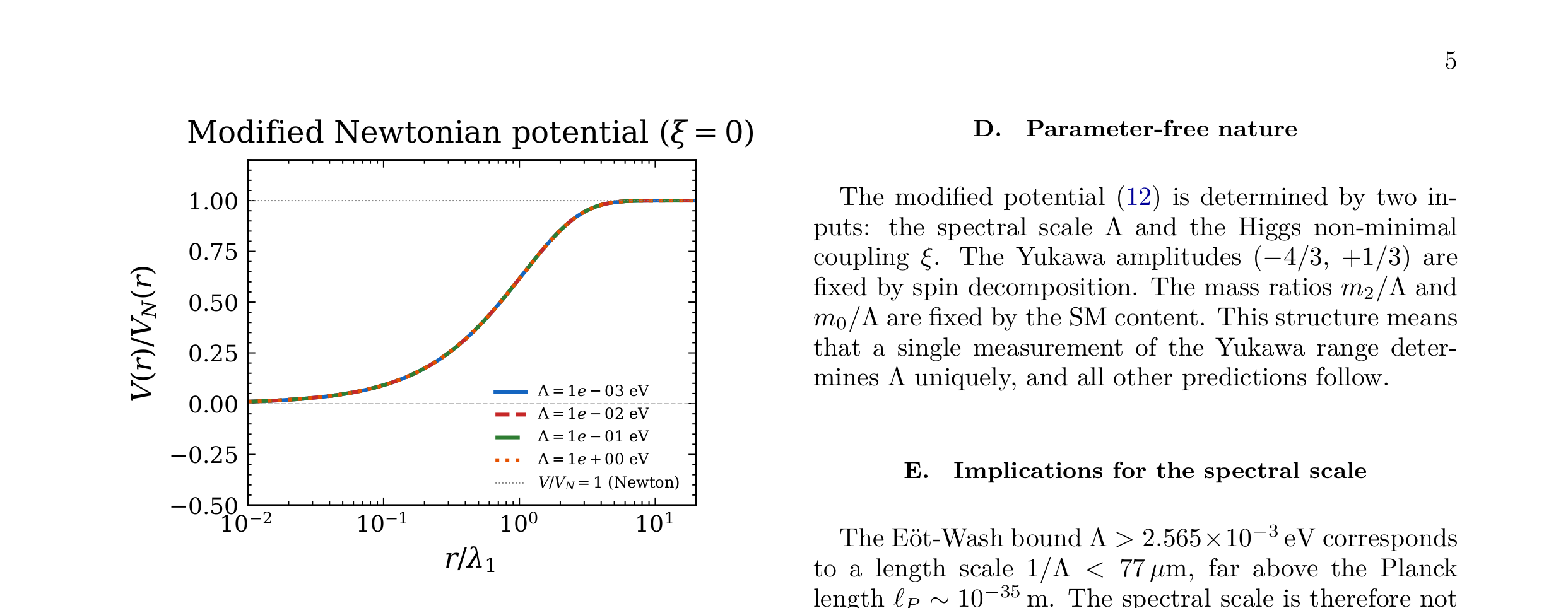
The potential ratio is plotted in Fig. 1 for several
values of .
Figure 1: Modified Newtonian potential as a
function of for several values of the non-minimal coupling
. At conformal coupling (dashed), the scalar mode
decouples and the potential dips to before recovering Newton’s
law. For all , the potential is finite at the origin
() and approaches exponentially for
.
III Post-Newtonian Parameter
III.1 Definition and derivation
The Eddington–Robertson–Schiff parameter measures the ratio
of the spatial and temporal metric potentials:
(15)
In GR, identically. Since
in the Newtonian limit, the ratio of
Eqs. (13) and (12) gives
(16)
III.2 Limiting behavior
For (which includes all solar-system distances for any
viable ), both exponentials are negligible and
with corrections
(17)
The leading correction is positive, spin-2 dominated, and exponentially
suppressed.
At with :
(18)
At minimal coupling (),
; at conformal coupling
(), , reflecting the absent scalar
cancellation.
III.3 Effective PPN table
For satisfying the experimental bounds derived below, the
departure from GR is negligible at all solar-system distances. The
effective PPN parameters are listed in Table 1. The
preferred-frame parameters and
the conservation-law parameters follow from the
diffeomorphism invariance of the spectral
action [Will:2014, Chamseddine:1996zu].
Table 1: Effective PPN parameters of the spectral action, evaluated at
solar-system distances .
The parameter requires the nonlinear
field equations and is not derived here.
Parameter
GR value
SCT value
Source
This work
Not yet derived
–
Diffeo. inv.
Diffeo. inv.
Conserv. law
IV Experimental Bounds on
The spectral scale sets the Yukawa range
. Experiments that probe deviations from the
inverse-square law or from GR constrain from below. We
consider five classes of experiments, ordered by the strength of the
resulting bound.
IV.1 Torsion-balance experiments (Eöt-Wash)
The most precise tests of the gravitational inverse-square law at
sub-millimeter distances are torsion-balance experiments by the
Eöt-Wash group [Lee:2020, Kapner:2007, Adelberger:2009].
The most recent result [Lee:2020] excludes Yukawa deviations with
at ranges (95%
CL).
The SCT spin-2 Yukawa has coupling , so the
exclusion curve is crossed at a shorter range than the
boundary. From the published exclusion contour at :
(19)
giving
(20)
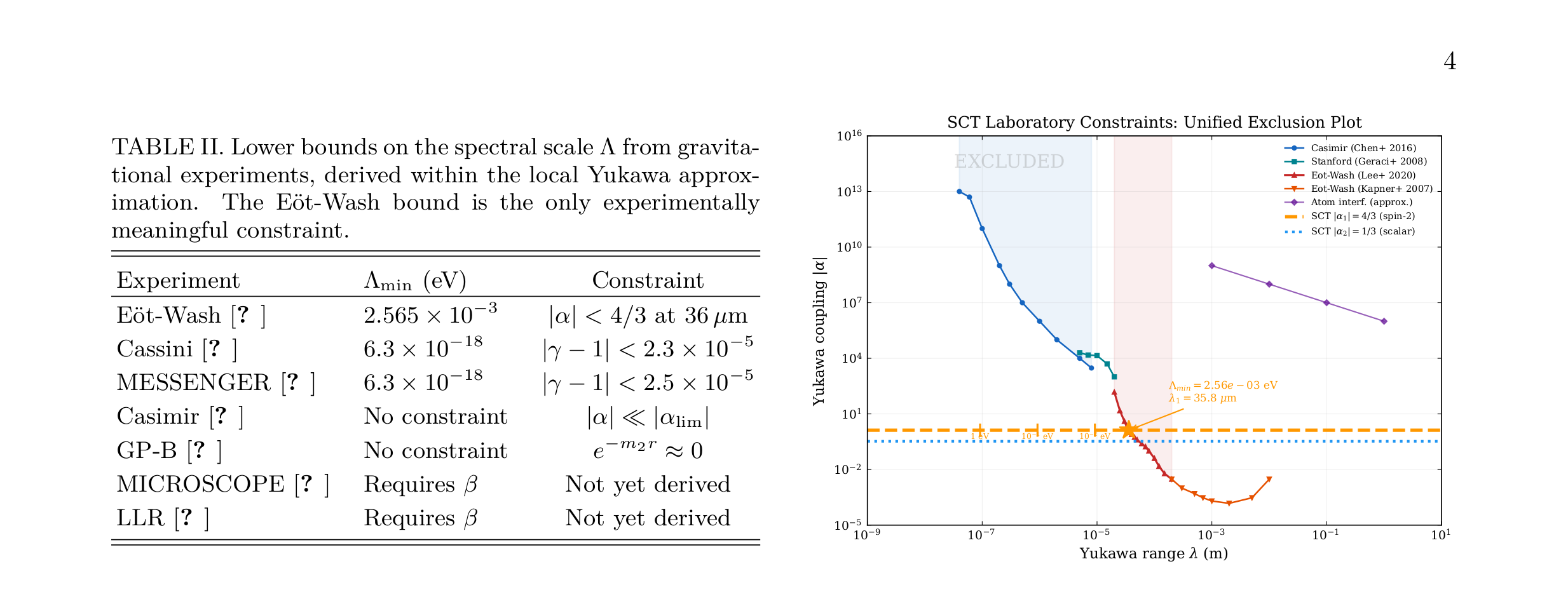
This is the primary laboratory bound on the SCT spectral scale. The
corresponding physical length is
, and the effective masses are
and
(at ).
The scalar Yukawa () produces a weaker constraint
because lies below the current exclusion curve at all
explored ranges.
IV.2 Cassini Shapiro time delay
The Cassini spacecraft measurement of the Shapiro time
delay [Bertotti:2003] constrains
at .
Using (17):
(21)
With :
(22)
This is fourteen orders of magnitude weaker than the Eöt-Wash bound,
reflecting the exponential suppression at astronomical distances.
IV.3 MESSENGER radioscience
The MESSENGER radioscience analysis [Verma:2014] provides
, yielding a comparable bound:
(23)
IV.4 Casimir experiments
Casimir force measurements at sub-micrometer
distances [Decca:2007, Chen:2016] require Yukawa couplings
to be detectable, far exceeding the SCT values
and . At
with , the potential
deviation is only , well below the experimental sensitivity.
Casimir experiments provide no constraint on .
IV.5 Satellite experiments and Lunar Laser Ranging
Gravity Probe B [Everitt:2011], MICROSCOPE [Touboul:2022],
Lunar Laser Ranging [Williams:2004], and atom
interferometry experiments probe gravity at centimeter-to-orbital
distances, where the SCT Yukawa corrections are suppressed by factors
of (atom interferometry at 1 cm) to
(Earth–Moon).
These experiments provide zero effective constraint on .
LLR also probes the Nordtvedt parameter
[Williams:2004], but since
has not been derived in the spectral action framework (it requires
nonlinear field equations), this bound cannot yet be evaluated.
If at leading order (as in GR), the Nordtvedt parameter
vanishes automatically. (MICROSCOPE [Touboul:2022] tests the
weak equivalence principle on test masses, not the Nordtvedt strong-EP
parameter.)
IV.6 Summary of bounds
Table 2: Lower bounds on the spectral scale from gravitational
experiments, derived within the local Yukawa approximation.
The Eöt-Wash bound is the only experimentally meaningful constraint.
Experiment
(eV)
Constraint
Eöt-Wash [Lee:2020]
at m
Cassini [Bertotti:2003]
MESSENGER [Verma:2014]
Casimir [Decca:2007]
No constraint
GP-B [Everitt:2011]
No constraint
MICROSCOPE [Touboul:2022]
Requires
Not yet derived
LLR [Williams:2004]
Requires
Not yet derived
Figure 2: Unified exclusion plot in the plane,
combining torsion-balance, Casimir, and satellite constraints. The
horizontal lines mark the SCT Yukawa couplings:
(spin-2, solid) and (spin-0, dashed). The
Eöt-Wash exclusion curve intersects at
, setting .
V Dependence on the non-minimal coupling
The Eöt-Wash bound depends on through : at conformal
coupling , the scalar Yukawa decouples and only the spin-2
channel contributes (the bound is then set entirely by ). Away from
conformal coupling, both Yukawa terms contribute but the spin-2 channel
dominates because .
The minimum spectral scale as a function of is plotted in
Fig. 3. The bound varies by less than 8% across the
full range , reflecting the dominance of the spin-2
constraint. At :
; at
: .
Figure 3: Minimum spectral scale as a function
of the Higgs non-minimal coupling , from the Eöt-Wash
constraint. The bound is nearly -independent because the spin-2
Yukawa channel dominates. At (conformal coupling,
vertical dashed), the scalar mode decouples and only the spin-2
constraint remains.Figure 4: Potential deviation as a
function of distance, evaluated at the boundary value
. The deviation is
at and drops below
by . The experimental sensitivity
thresholds for Eöt-Wash and Casimir experiments are indicated.
VI Discussion
VI.1 Validity of the Yukawa approximation
The local Yukawa approximation replaces the full propagator denominator
by its small- limit
. The exact dressed propagator has a zero at
[Alfyorov:2026ff], yielding an exact spin-2
mass ,
smaller than the Yukawa-approximation value
by a factor of .
The exact Yukawa range is therefore longer than the
approximation predicts, making the stated Eöt-Wash bound on
conservative: the full nonlocal analysis would yield a
tighter constraint.
For solar-system experiments (), the Yukawa
corrections are exponentially suppressed regardless of the
approximation, so the local and exact results are indistinguishable at
current precision.
VI.2 Comparison with Stelle gravity
In Stelle’s local quadratic gravity [Stelle:1976gc, Stelle:1978],
the potential has the same functional form (12) but with
arbitrary masses and determined by two free coupling
constants. The spectral action eliminates this freedom: the couplings
and are computed from the
SM particle content, yielding definite effective masses (9)
and (10) as functions of alone (plus ).
VI.3 Ghost interpretation
The spin-2 mass corresponds to a ghost mode: the coefficient of
in (12) is , indicating that the massive
spin-2 graviton couples with wrong-sign residue. This is the well-known
Ostrogradsky ghost of higher-derivative
gravity [Stelle:1976gc, Woodard:2015zca].
In the spectral action framework, the dressed propagator
has a pole at with residue
, approximately 50% suppressed relative to the
Stelle value .
The physical interpretation of this ghost (Lee–Wick field, fakeon, or
dark matter candidate) is deferred to a dedicated analysis.
VI.4 Parameter-free nature
The modified potential (12) is determined by two inputs:
the spectral scale and the Higgs non-minimal coupling .
The Yukawa amplitudes (, ) are fixed by spin decomposition.
The mass ratios and are fixed by the SM
content. This structure means that a single measurement of
the Yukawa range determines uniquely, and all other predictions
follow.
VI.5 Implications for the spectral scale
The Eöt-Wash bound
corresponds to a length scale , far
above the Planck length . The
spectral scale is therefore not directly constrained to lie near the
Planck mass by current experiments; it could be much higher. Future
improvements in short-range gravity experiments, targeting
, would push the bound to
.
VII Conclusions
We have derived the post-Newtonian parameter and laboratory constraints
on the spectral action with Standard Model content. The modified
Newtonian potential (12) has its Yukawa
amplitudes, with effective masses set by the particle content and the
spectral scale .
The central experimental result is:
corresponding to (Yukawa range
). All solar-system tests
are satisfied with exponential margin. Casimir, atom interferometry, and
satellite experiments are below their sensitivity thresholds for the SCT
coupling strengths.
The spectral action passes all currently available gravitational tests.
The most promising avenue for future improvement is the extension of
torsion-balance experiments to shorter ranges, which would directly
constrain in the meV regime.
Acknowledgements.
Numerical results were obtained using mpmath and
scipy and verified to 100-digit precision.
AI Disclosure
In preparing this manuscript, large language model tools (specifically
Anthropic Claude Opus 4.7 and OpenAI ChatGPT GPT-5.5 Pro) were used for
English-language editorial assistance, bibliographic cross-checking,
LaTeX markup verification, and the writing of computational code and
numerical-verification scripts that were subsequently audited by the
author. All mathematical derivations, the choice of observables, the
comparison against Cassini, lunar-laser-ranging, and short-range
torsion-balance constraints, the figures, the interpretations, and the
conclusions are the author’s own. Every numerical value reported in
the manuscript was computed by software written by the author (with AI
assistance as declared) and was cross-checked against the
canonical-validator modules of the upstream Spectral Causal Theory
program at 100-digit precision. Every citation was individually
verified against arXiv, Crossref, or the journal page of record. AI
tools are not listed as authors and bear no authorial responsibility
for this manuscript.
Data Availability
The computational tools and experimental data references used in this
work are available from the author upon reasonable request.
References
References
Figures
2 extracted
Provenance
100% pipeline
Source uploaded
PDF compiled
HTML compiled
Metadata fixed (title, authors, categories)
AI disclosure recorded
Mirrored to AT-Proto PDS
OpenXiv id assigned
done
Indexed for semantic search
Bridged to Bluesky
done
Living Seminar
Paper-scoped discussion. Author can pin one post and mark questions
best unresolved; mods can hide off-topic posts.
No comments yet. Start the seminar.
Cite
David Alfyorov (2026). Solar system and laboratory tests of the spectral action scale. OpenXiv openxiv:gr-qc.2026.00004. https://openxiv.net/abs/gr-qc.2026.00004
@article{openxiv:openxiv_gr_qc_2026_00004,
  title  = {Solar system and laboratory tests of the spectral action scale},
  author = {David Alfyorov},
  year   = {2026},
  journal = {OpenXiv},
  url    = {https://openxiv.net/abs/gr-qc.2026.00004},
  note   = {OpenXiv id: openxiv:gr-qc.2026.00004}
}