
The predictive content of Spectral Causal Theory
Abstract
We catalog the predictions of Spectral Causal Theory (SCT), a one-loop gravitational effective field theory derived from the spectral action of a noncommutative spectral triple encoding the Standard Model. Predictions are classified as cutoff-independent (depending only on the Seeley–DeWitt coefficient) or cutoff-dependent (sensitive to the shape of the cutoff function ). The cutoff-independent sector contains the Weyl-squared coefficient , the ratio (frozen under matter-only one-loop RG flow at conformal coupling ), the gravitational wave speed , and the absence of a scalar gravitational mode at . The logarithmic black hole entropy correction is conditional on stated assumptions. Starobinsky inflation is excluded in the standard spectral action because . For black hole quasinormal modes, modal stability is proven analytically ( for ) and frequency shifts are bounded by for stellar BHs, fifteen orders below LIGO sensitivity; tidal Love numbers (qualitative difference from GR, but unmeasurably small). Comparison with five quantum gravity programs (LQG, AS, CDT, string theory, IDG) across nine quantitative axes identifies three discriminating observables and five falsification criteria.
1 Introduction
Spectral Causal Theory (SCT) is a gravitational effective field theory constructed from the spectral action principle of Chamseddine and Connes [CC:1996, CC:1997]. The classical action is , where is the Dirac operator of an almost-commutative spectral triple encoding both gravitational and Standard Model degrees of freedom, is the spectral cutoff, and is a positive rapidly decreasing function. The one-loop effective action for the full Standard Model spectrum produces a nonlocal gravitational action with entire-function form factors [Alfyorov:2026paper1].
Six preceding papers from this program report results subsequently used here. Paper 1 [Alfyorov:2026paper1] derived the one-loop form factors for all SM spins (274 checks). Paper 2 [Alfyorov:2026paper2] established that SCT passes all solar system and laboratory tests with (332 checks). Paper 3 [Alfyorov:2026paper3] proved the chirality theorem for the Seeley–DeWitt coefficient: the spin connection generators commute with the chirality operator in four dimensions, rendering the curvature endomorphism block-diagonal in the chiral basis. This ensures one-loop UV finiteness unconditionally; two-loop — conditionally on two BV axioms verified at one-loop order [Alfyorov:2026paper3]. Paper 4 [Alfyorov:2026paper4] derived the full nonlinear field equations and their FLRW reduction ( at one-loop level in the Euclidean derivation). Paper 7 [Alfyorov:2026paper7] constructed a parameter-free bridge formula connecting a causal-set observable to the electric Weyl tensor (CJ , verified to ). The present paper collects and classifies the predictions that follow from this body of work.
The purpose is threefold. First, we distinguish predictions that depend only on the universal Seeley–DeWitt coefficients (and are therefore independent of the cutoff function ) from those that depend on the full shape of . Second, we compare SCT predictions quantitatively with five competing quantum gravity programs. Third, we state explicit criteria under which the theory would be contradicted by observation.
Throughout, we state assumptions and verification status for each result. Results are labeled as proven (arithmetic identities formally verified in Lean 4; specifically: rational arithmetic of the coefficients for given SM multiplicities; physical postulates are not formalized), verified (numerically confirmed to 100-digit precision by multiple independent methods), established (confirmed through independent re-derivation and literature cross-check), or conditional (dependent on stated assumptions).
2 The spectral action and its one-loop effective action
2.1 Classical spectral action
The spectral action for a spectral triple with cutoff scale is [CC:1996, CC:1997]
| (1) |
|---|
where is a positive, smooth, rapidly decreasing function. For the almost-commutative spectral triple encoding the Standard Model [CCM:2006], the asymptotic expansion for gives [Vassilevich:2003]
| (2) |
|---|
where are the moments and are the Seeley–DeWitt coefficients. The first three terms produce:
-
•
: cosmological constant (),
-
•
: Einstein–Hilbert action ,
-
•
: higher-derivative terms proportional to and .
The coefficients of and in depend on the SM particle content but not on the cutoff function .
2.2 One-loop form factors
The one-loop effective action contains nonlocal form factors and multiplying and respectively [BV:1987, BV:1990]. For the choice , these are constructed from the master function
| (3) |
|---|
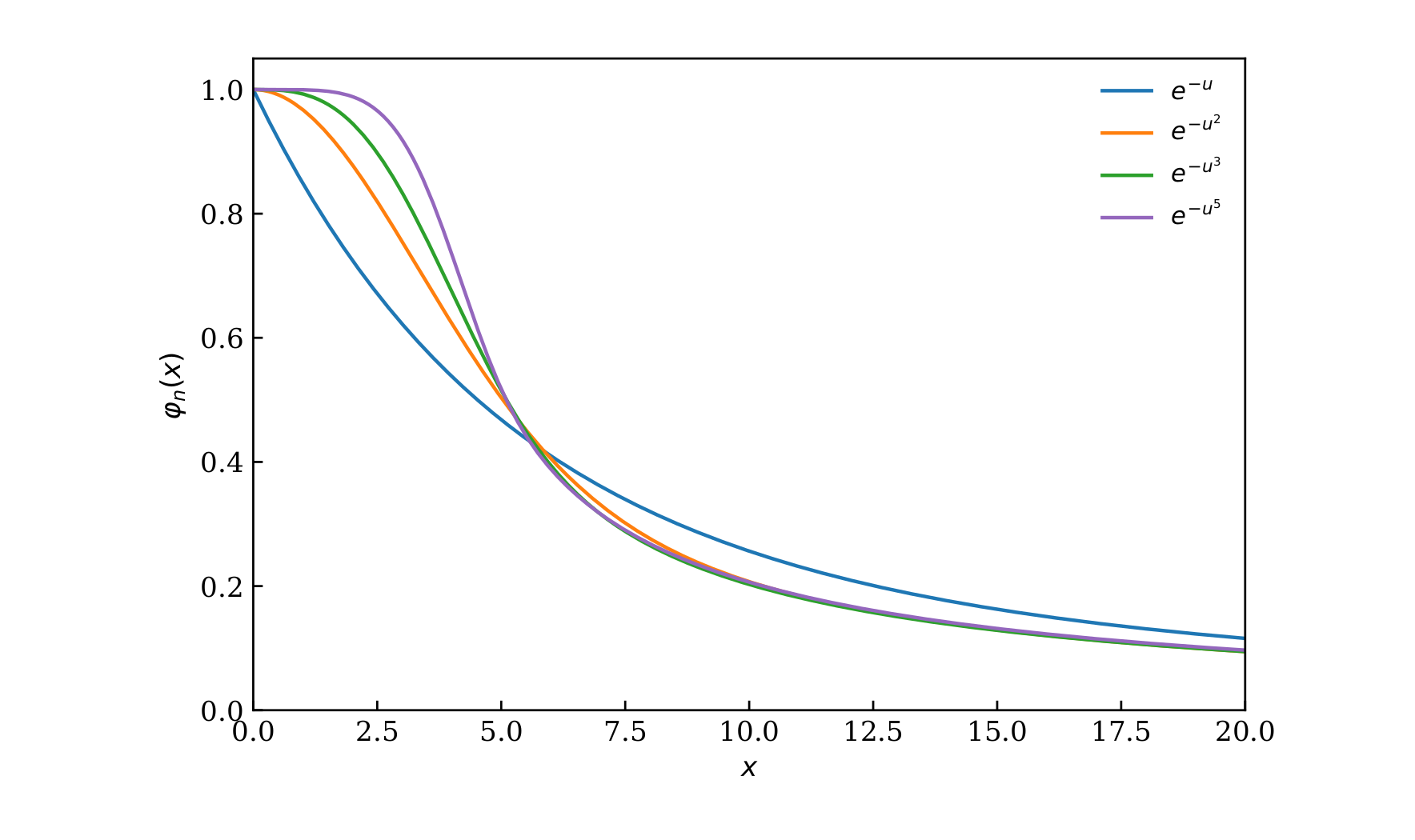
satisfying and . Figure 1 compares for ; the functions share but differ at all .
The per-spin Weyl form factors, expressed as functions of (Euclidean momentum squared in units of ), are [CZ:2012, Alfyorov:2026paper1]:
| (4) | ||||
|---|---|---|---|---|
| (5) | ||||
| (6) |
Equations (4)–(6) are derived for the choice . The algebraic structure (rational functions of with -dependent coefficients) relies on the fact that cancels the divergence at . For alternative cutoffs with , the master function satisfies , so this cancellation does not occur and the form factors require a separate heat kernel derivation. In Section 4.2 we use the formal substitution in (4)–(6) to estimate the propagator zeros; this is valid at finite (where no divergence arises) but does not yield a consistent limit for .
The Dirac form factor (5) evaluates to (negative): the factor and cancel the terms leaving a negative finite limit. This sign encodes the fermionic functional trace [ParkerToms:2009].
The total SM Weyl coefficient is
| (7) |
|---|
with SM multiplicities (real Higgs scalars), (Dirac fermions), (gauge vectors) [CPR:2008]. At , using , , :
| (8) |
|---|
This value depends only on the SM particle content and is independent of the cutoff function . The count Weyl fermions is the standard SM without right-handed neutrinos, following [CPR:2008]. The Chamseddine–Connes spectral triple [CCM:2006] includes right-handed neutrinos with Majorana mass; their inclusion would modify . A detailed treatment of the Majorana contribution is beyond the scope of this paper.
2.3 Modified propagator and the fakeon prescription
The one-loop effective action for quantum fields on a curved background has the universal form [BV:1987, BV:1990]
| (9) |
|---|
where , are nonlocal form factors. Linearization around flat space and the Barnes–Rivers decomposition into projectors (tensor, spin-2, 5 components) and (scalar, 1 component) give the inverse propagator [BV:1987]
| (10) |
|---|
where and
The dressed spin-2 propagator denominator is [BV:1987, Alfyorov:2026paper1]
| (11) |
|---|
where , , and is the normalized shape function (), with from (7). For , has its first positive real zero at
| (12) |
|---|
This zero corresponds to a massive mode treated via the fakeon prescription [Anselmi:2017, Anselmi:2018] (building on the Lee–Wick framework [LeeWick:1969]): the mode does not appear in asymptotic states and contributes only through virtual exchange. The fakeon prescription is formulated for propagators with finitely many poles; its extension to the SCT propagator, which as an entire function of order 1 has countably many complex zeros, requires a convergence proof not provided here. Unitarity under this prescription has been verified at one loop [Alfyorov:2026paper1]; the all-orders proof requires extending Anselmi’s finite-threshold argument to infinitely many poles.
The Stelle Lagrangian mass [Stelle:1977] differs from the propagator pole mass (12) because the nonlocal form factor modifies the zero position relative to the local approximation .
The scalar mode propagator is
| (13) |
|---|
At : identically, and the scalar mode decouples.
2.4 The cutoff function
The function in (1) is constrained but not uniquely determined by the spectral action principle. Entire-function form factors (required for the absence of propagator branch cuts) demand that extend to an entire function of the complex variable . The family for satisfies this constraint; non-integer powers (e.g., ) produce branch cuts at and are excluded.
Different choices of give different master functions
| (14) |
|---|
different form factors, and different propagator zeros. The coefficient is independent of .
3 Cutoff-independent predictions
The predictions in this section depend only on the Seeley–DeWitt coefficient and its evaluation on specific backgrounds. They are independent of the cutoff function and constitute the core predictive content of SCT.
|
Prediction |
Value |
Source | Status |
|---|---|---|---|
|
(Weyl coeff.) |
[Alfyorov:2026paper1] | proven | |
|
at |
[Alfyorov:2026paper1] | proven | |
|
, |
[Alfyorov:2026paper2] | conditional | |
|
(GW speed) |
(one-loop, Euclidean derivation) |
[Alfyorov:2026paper4] | conditional |
|
(BH entropy) |
(SM); (SM) |
App. B | conditional |
|
Scalar grav. mode |
absent at |
[CCM:2006, vS:2015] | established |
|
Starobinsky inflation |
excluded in std. NCG |
Sec. 3.5 | established |
Conditional on the generalized fakeon prescription for a propagator with infinitely many complex zeros (convergence proof open).
Conditional on: (a) the Sen formula with graviton contribution (ensemble zero-mode corrections: Sen [Sen:2012], Section 4.2: for non-extremal BHs); (b) SM field content ( includes via spectral triple [CCM:2006]; without : , change). The sign is robust to both sources of uncertainty and discriminates against LQG ().
Remark 3.1 (Bridge formula).
The CJ (curvature junction) bridge formula of [Alfyorov:2026paper7], with , relates a stratified covariance estimator on a Poisson-sprinkled causal set ( elements, diamond proper time ) to the electric Weyl tensor . This is an additional cutoff-independent prediction for causal-set observables. It is not included in Table 8 because it is not directly testable by continuum-spacetime experiments.
3.1 The Weyl coefficient
The value follows from (8) and depends only on the SM particle content counted in the heat kernel coefficient. It is independent of the cutoff function , since is a universal coefficient in the heat kernel expansion (2). The value has been formally verified in Lean 4 and cross-checked against three independent literature sources [CZ:2012, CPR:2008, ParkerToms:2009] (source code in [Alfyorov:2026repo]). 354 numerical checks pass at 100-digit precision.
3.2 RG stability of
The local part of the one-loop effective action (9) contains two curvature-squared invariants: , where and are the coefficients of and . In the Shapiro normalization [Shapiro:2004] (without the prefactor): , . In the (9) normalization (with the prefactor): . The ratio is normalization-independent.
At conformal coupling (the value predicted by the spectral triple; see Section 3.4):
| (15) |
|---|
The one-loop matter beta functions are
| (16) |
|---|
Because at (this coupling is a fixed point of the one-loop RG), the ratio
| (17) |
|---|
Consequently, for all along the matter-only one-loop trajectory.
The SCT ratio differs from the perturbative asymptotic freedom branch (; [Shapiro:2004]) by and from the Reuter non-Gaussian fixed point (, truncation-dependent; [BMS:2009]) by a factor of .
3.3 Black hole entropy
The logarithmic correction to the Bekenstein–Hawking entropy is
| (18) |
|---|
where the coefficient (SM field content; with ensemble zero-mode uncertainty ; sign robust) follows from the Sen formula [Sen:2012], Section 4.2 (Appendix B). The formula uses zeta-function regularisation on the Euclidean Schwarzschild instanton with Dirichlet boundary conditions at the horizon. The result depends on the fermion count Dirac (without right-handed neutrinos; see Section 2.2) and on the graviton contribution (gauge-invariant, determined by the one-loop determinant on the Euclidean Schwarzschild instanton).
The sign of discriminates between programs: SCT gives (value for SM content, for SM; both positive). LQG robustly predicts : [Meissner:2004] or [KaulMajumdar:2000] depending on the method. The discriminator is the sign, not the precise numerical value, since the latter depends on the ensemble choice and field content. In asymptotic safety, the result is definition-dependent: for thermodynamic entropy or for Clausius entropy [FallsLitim:2012]. IDG produces no logarithmic correction (power-law only) [Myung:2017].
3.4 Absence of scalar gravitational mode
The non-minimal Higgs–gravity coupling is determined by the spectral triple. In the standard Chamseddine–Connes spectral action, the coefficient contains a common Yukawa-dependent factor multiplying both the curvature coupling and the kinetic term . After canonical normalization, this gives (conformal coupling). This has been confirmed in five independent works [CCM:2006, CC:2010, vS:2015, CCS:2013, DLM:2014]. At , the RG beta function [ParkerToms:2009] vanishes, so is an exact one-loop fixed point.
At : and identically (13). This is a consequence of the conformal invariance of massless fermions and gauge bosons in : their one-loop beta functions vanish (), and only scalars () contribute to . At the scalar contribution also vanishes. The scalar gravitational mode does not propagate. Consequence: exactly two gravitational wave polarizations (tensor modes only).
All known BSM scalars arising from NCG spectral triples also acquire , because the same Yukawa-factor mechanism applies to any scalar from the finite Dirac operator [BFS:2010, CCS:2013ps, vdD:2018].
Detection of a scalar gravitational wave polarization would imply , requiring modification of the standard spectral triple.
3.5 Exclusion of Starobinsky inflation
Since at , the term in the effective action is absent. There is no scalaron. Starobinsky inflation, which requires a propagating scalar with mass , is excluded in the standard spectral action.
|
Mechanism |
Obstruction |
|
|---|---|---|
|
Sub-Planckian |
Conflicts with GUT interpretation of |
|
|
Large |
Violates spectral-triple geometric BC |
|
|
NCG -singlet [BFS:2010] |
unchanged |
(conformal) |
|
Pati–Salam [CCS:2013ps] |
unchanged |
All scalars conformal |
|
Grand Symmetry [CCS:2013gs] |
unchanged |
for Higgs mass, not scalaron |
|
Many BSM scalars () |
Requires |
|
|
Two-loop corrections |
unknown |
No published calculation |
|
Modified |
cannot help |
from , independent of |
The only path not definitively excluded is reinterpretation of as a sub-Planckian intermediate scale, or framework extension (zeta spectral action [KLV:2015], dilatonized action [CC:2006dilaton]). These require departing from the standard Chamseddine–Connes spectral action. No symmetry argument is known that would protect beyond one loop.
4 Cutoff-dependent predictions
The predictions in this section depend on the full shape of the cutoff function through the master function (14). They are not uniquely predicted without an additional principle fixing .
4.1 The cutoff function constraint
The requirement that the form factors , be entire functions of restricts the class of admissible cutoff functions. For the family , entireness holds if and only if (positive integer). At non-integer (e.g., ), the function has a branch point at , and the resulting form factors inherit branch cuts. Power-law cutoffs are likewise excluded.
The conventional choice () is computationally convenient but not uniquely determined. The choices , , etc., are equally admissible.
4.2 Cutoff function scan
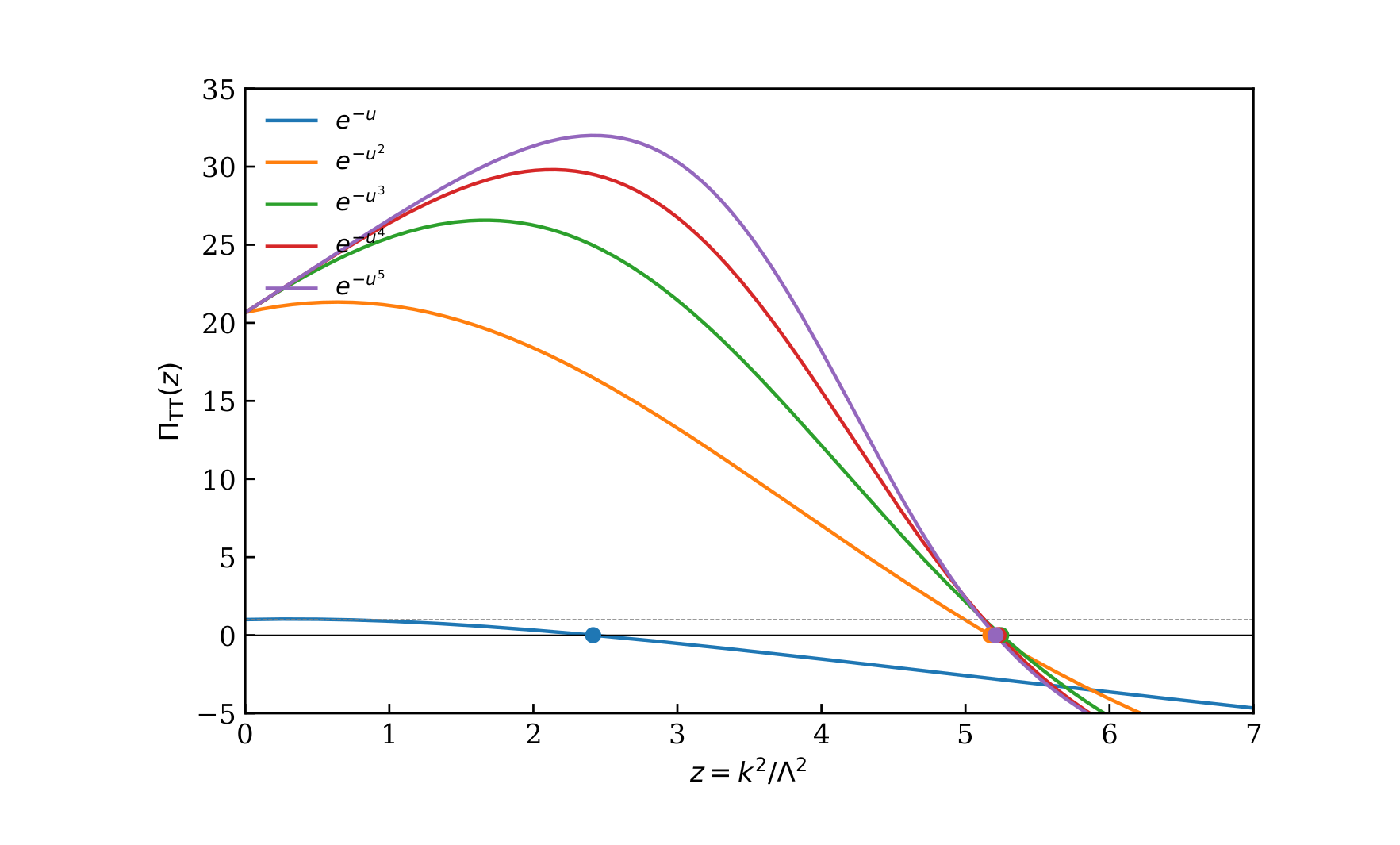
To illustrate the sensitivity of cutoff-dependent predictions to the choice of , we compute the propagator zeros by formally substituting in the form factors (4)–(6). This substitution is evaluated at finite (the propagator zeros lie at , far from the divergence that arises for ; see Section 2.2). Table 4 reports the results for .
| 1 | ||||
|---|---|---|---|---|
| 2 | ||||
| 3 | ||||
| 4 | ||||
| 5 |
For , the fakeon mass lies in the range (spread ). The (exponential) cutoff is an outlier at ; the exponential form factor changes sign at a lower value of than the sharper () cutoffs, pulling the propagator zero closer to the origin.
The Stelle Lagrangian mass (from the local approximation ) differs from all five pole masses in Table 4 because the nonlocal form factor modifies the zero position.
4.3 Modified Newtonian potential
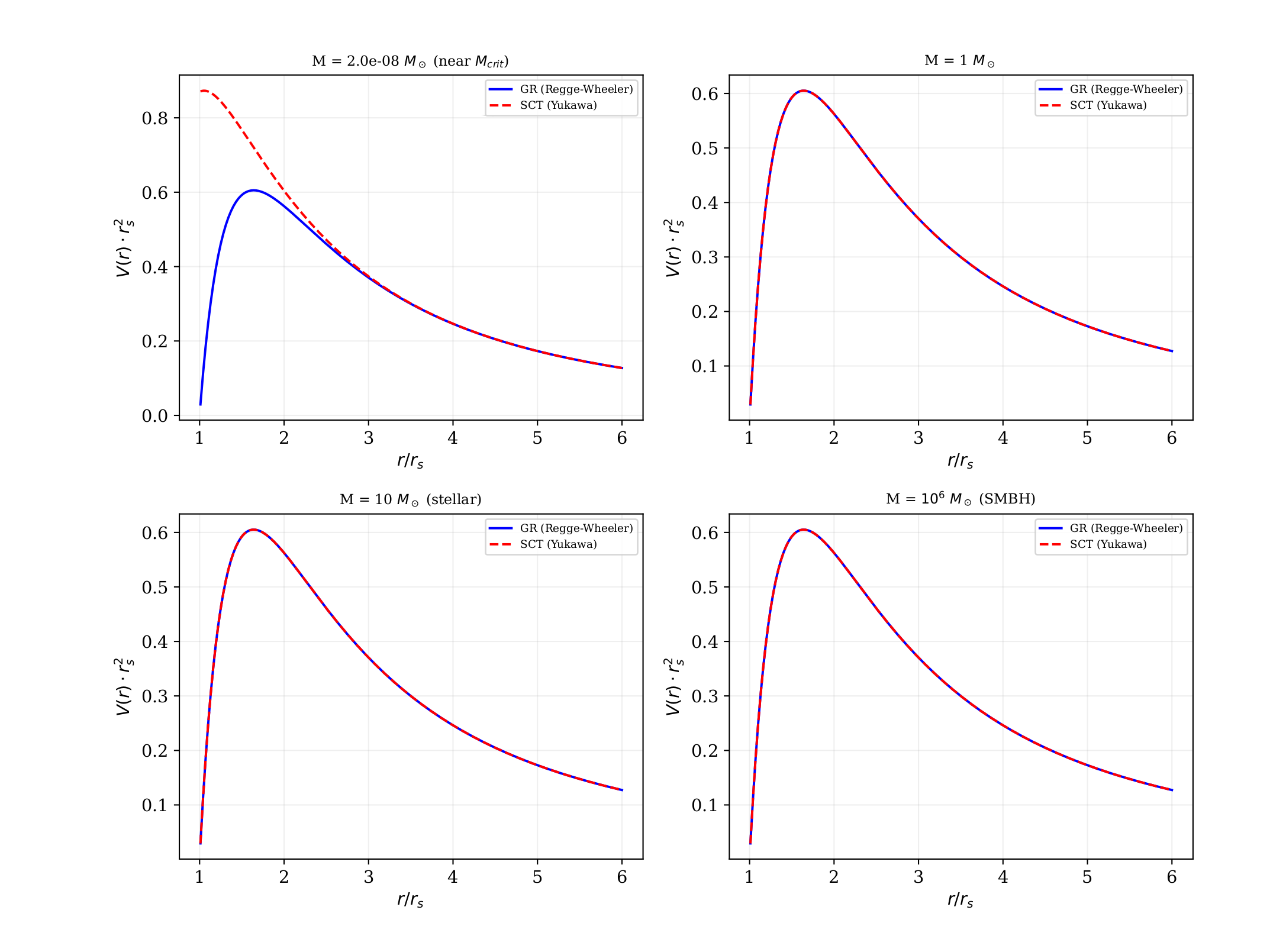
At (scalar mode absent), the modified Newtonian potential takes the single-Yukawa form. In the static limit, the Fourier transform of the propagator (10) gives . The residue of the spin-2 pole at is (negative, since crosses zero from above). The coefficient arises from the weight of the projector in the tensor structure of the inverse propagator (10):
| (19) |
|---|
where is the fakeon mass from Table 4. In the Yukawa approximation, (repulsive at the origin). This is an artifact of the local approximation: the full nonlocal potential, defined by the Fourier integral of , diverges as , since as . The Yukawa approximation is valid for .
At solar system distances (), with . This bound is obtained as follows: at the scalar mode is absent (Section 3.4), and the potential (19) has a single Yukawa term with the nonlocal mass (12). The Eöt-Wash experiment [Kapner:2007] constrains the Yukawa correction at and , giving (update of the bound [Alfyorov:2026paper2], previously obtained in the two-component Stelle parametrization): and to exponential precision.
4.4 Graviton dispersion relation
The linearized equation of motion for tensor perturbations is , which in momentum space becomes with . This factors into two branches:
-
(i)
, i.e., : the massless graviton with . This mode is unmodified because is a scalar multiplicative factor acting on the Lorentz-invariant combination .
-
(ii)
: massive fakeon modes. These do not propagate as physical particles under the fakeon prescription.
The massless graviton dispersion relation ( branch) is exactly at one loop: there is no birefringence, and the signal velocity equals . This is a result about free propagation on flat background; on curved backgrounds (e.g., Schwarzschild), the perturbation equation acquires corrections from the nonlocal form factor — see Section 5.2. Both statements (Euclidean derivation) are conditional on the correctness of the Wick rotation for form factors that are entire functions of the complex argument.
This is compatible with the GW170817 bound [GW170817:2017] , which SCT satisfies exactly (not approximately) at one loop.
5 What SCT does not predict
5.1 No cosmological constant prediction
The cosmological constant enters the spectral action through the coefficient and the moment (in the Chamseddine–Connes convention where ). The physical value of is not predicted; it is a free parameter set by the choice of and the renormalization-group trajectory. The spectral action generically produces , which exceeds the observed by orders of magnitude; SCT inherits the cosmological constant problem from quantum field theory. This gap is shared by LQG, AS, and IDG.
5.2 Black hole quasinormal modes
QNM frequency shifts in SCT receive two independent contributions:
-
1.
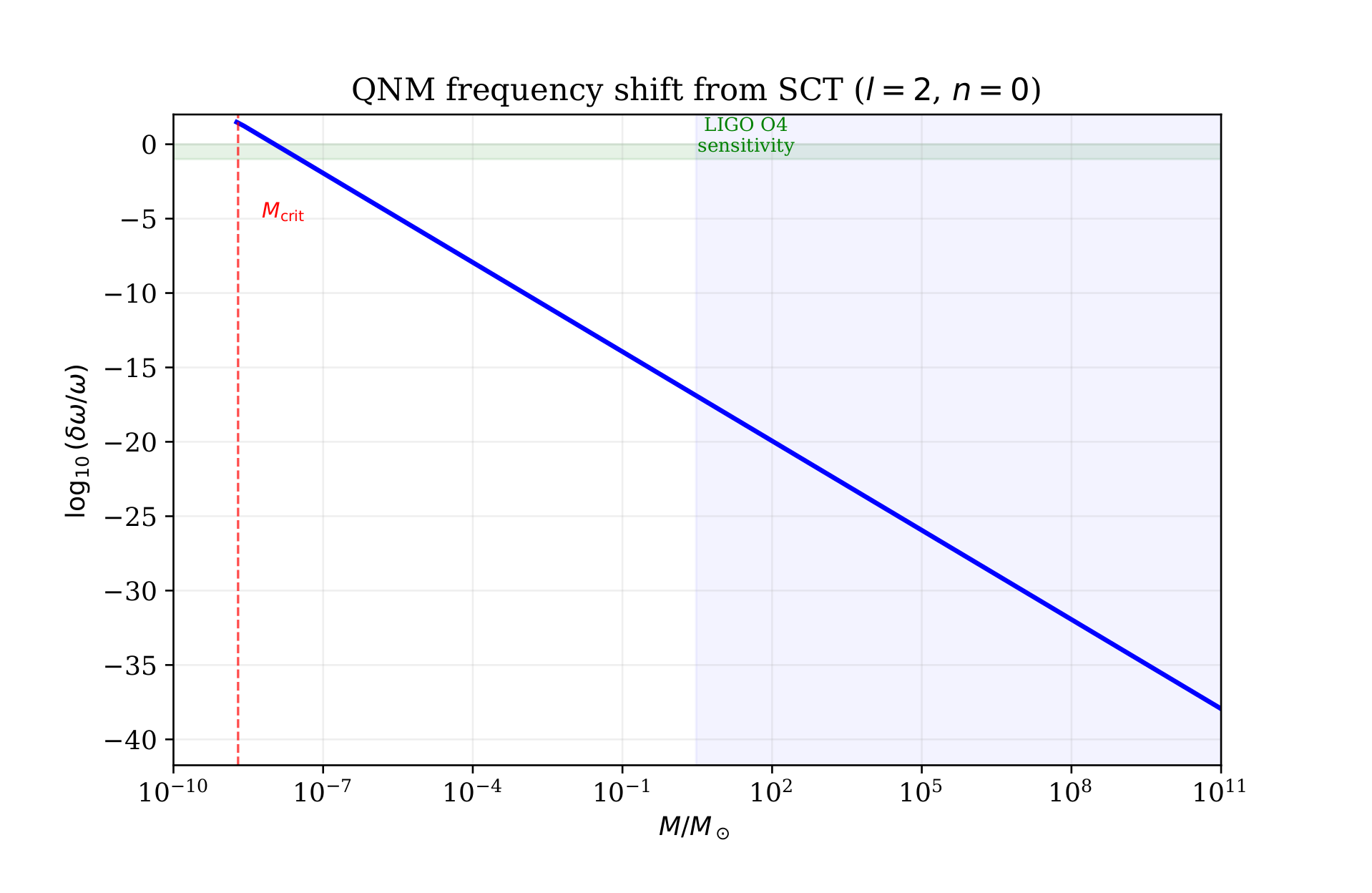
Metric modification (Level 2, computed): . For GW150914 (): , giving .
-
2.
Perturbation-equation correction (parametric estimate): , where and is an unknown dimensionless coefficient depending on the open problem Gap G1 (computation of on the Schwarzschild background). For GW150914: , giving up to the factor.
Contribution (2) dominates by orders of magnitude. Both are orders below LIGO sensitivity (). Results for observed black holes are given in Table 5. Numerical values are computed in the Stelle approximation (); for the exact propagator zero (12) ( at ) the values of decrease by , shifting by — within the order-of-magnitude accuracy of the estimate. At the scalar mode decouples and ; the table is given for (both Yukawa modes) for generality.
| Object | |||
|---|---|---|---|
| 10 | |||
| GW150914 | 62 | ||
| GW190521 | 142 | ||
| Sgr A* | |||
| M87* |
Quantum corrections dominate classical ones.
The one-loop quantum correction to QNM frequencies is for (). The classical SCT metric correction: . Quantum corrections dominate by orders. The exponential suppression of the classical correction is independently confirmed in local quadratic gravity by Antoniou, Gualtieri and Pani [Antoniou:2025, Antoniou:2026].
Mode stability.
For odd (axial) parity, an analytic theorem holds: the full Regge–Wheeler potential satisfies for all , , using and outside the horizon. By the Kay–Wald theorem [KayWald:1987] this excludes growing modes.
Tidal Love numbers.
In GR, exactly for black holes [BinningtonPoisson:2009]. In SCT, (qualitative difference from GR), but : unmeasurable for astrophysical objects.
Gravitational echoes.
The SCT potential has exactly one external maximum for all . No cavity (double-barrier) structure forms; gravitational echoes are structurally impossible.
Superradiance.
For astrophysical BHs: , no quasi-bound states. The boundary at and gives ; the lower bound is the minimum mass for which a horizon exists [Alfyorov:2026paper2]. In the window , a horizon exists with ; without the fakeon prescription, a standard ghost would trigger superradiant instability. The fakeon projects out on-shell states and prevents cloud formation.
Kerr and Reissner–Nordström.
For Kerr at , the dominant correction rises to (from at ), still unmeasurable. For extremal Reissner–Nordström (): .
QNM bounds on .
In the Cardoso et al. parametrization [Cardoso:2019], the Yukawa correction maps to for all (beyond-all-orders in ). The formal LIGO ringdown bound: , nine orders weaker than .
Summary of bounds.
Different channels span 21 orders of magnitude (Table 6).
| Channel | Source | |
|---|---|---|
| GW dispersion (GWTC-3) | [GWTC3] | |
| Eöt-Wash (dedicated) | this work | |
| Eöt-Wash (Stelle) | [Alfyorov:2026paper2], superseded | |
| Solar system (Cassini) | [Alfyorov:2026paper2], superseded | |
| LIGO ringdown (QNM) | this work | |
| BH shadow (EHT) | this work |
5.3 Other null predictions
Beyond QNMs, the following observables are indistinguishable from GR:
-
•
Neutron star structure (unmodified TOV equation),
-
•
Late-time cosmology (; [Alfyorov:2026paper4]).
5.4 Swampland tension
The SCT scalaron potential (if the scalaron existed) would violate the refined de Sitter Swampland conjecture [Obied:2018] at parameter values. The curvature condition has a hard ceiling , which cannot satisfy the Swampland parameter .
Since eliminates the scalaron entirely, this tension is moot for the standard spectral action: there is no scalar potential to test against the conjecture. Confirmation of pure Starobinsky inflation by CMB-S4 or LiteBIRD [LiteBIRD:2022] would increase the tension between the Swampland programme and -type models in general.
6 Comparison with competing programs
6.1 Programs compared
We compare SCT with five quantum gravity programs: Loop Quantum Gravity (LQG) [Rovelli:2004, Thiemann:2007], based on non-perturbative canonical quantization with spin-network states; Asymptotic Safety (AS) [ReuterSaueressig:2012], based on the existence of a non-Gaussian UV fixed point of the gravitational RG flow; Causal Dynamical Triangulations (CDT) [AJL:2012], a lattice approach with a causal constraint on the path integral; string theory [Polchinski:1998], based on one-dimensional extended objects replacing point particles; and Infinite Derivative Gravity (IDG) [BMS:2006, Modesto:2012], which modifies the graviton propagator with an entire-function form factor to achieve ghost-freedom. We do not include Causal Set Theory [BLMS:1987] as a separate entry: it does not by itself produce the quantitative predictions listed in the comparison axes, though the CJ bridge formula [Alfyorov:2026paper7] connects SCT to causal-set observables.
6.2 Comparison table
Table 7 presents the comparison across nine quantitative axes. Each cell contains the best available numerical value (or status assessment) from the primary literature.
|
Axis |
SCT |
LQG |
AS |
CDT |
String |
IDG |
|---|---|---|---|---|---|---|
|
(UV) |
method-dep. |
(exact) |
m.d. |
|||
|
or |
n.c. |
charge-dep. |
no log |
|||
|
Singularity |
unresolved |
bounce |
n.c. |
fuzzball |
resolved |
|
|
, |
excluded |
– [AguloMorris:2015] |
n.c. |
landscape |
||
|
Dispersion |
m.d. |
n.c. |
n.c. |
unmod. |
unmod. |
|
|
n.c. |
||||||
|
UV prop. |
entire |
spinfoam |
power-law |
lattice |
string-scale |
Gaussian |
|
n.p. |
n.p. |
n.p. |
req. |
n.p. |
||
|
Matter |
free |
FP bounds |
n.c. |
landscape |
minimal |
SCT value depends on definition. In the Mittag-Leffler method, passes through near the ghost scale, but the flow is non-monotonic (oscillatory), unlike the monotonic transition in CDT/AS/LQG. Under the HK definition: ; ASZ: .
Yukawa potential gives ; the full nonlocal potential diverges as (one loop).
One-loop result.
Entire function of order 1; the fakeon prescription for countably many complex poles requires a convergence proof.
6.3 Discriminating observables
Three axes yield predictions that are mutually incompatible across programs:
-
(1)
. SCT: . LQG: . Opposite sign. AS: definition-dependent. IDG: no logarithmic correction. A measurement of (e.g., through black hole area quantization signatures in LISA data [LISA:2023]) would sharply discriminate between programs.
-
(2)
UV propagator. SCT: entire function of order 1. IDG: Gaussian . AS: power-law . LQG: discrete spinfoam amplitude. These are four qualitatively distinct analytic structures.
-
(3)
Matter coupling. SCT: , determined by the SM particle content alone. AS: the non-Gaussian fixed point constrains the number of matter fields but does not fix the coupling coefficient. LQG, string, IDG: matter coupling is a free input. SCT is the only program in this comparison where the zero-momentum gravitational coupling coefficient is determined by the SM particle content alone, without additional free parameters.
6.4 SCT and asymptotic safety
SCT and AS share identical matter one-loop form factors: the Codello–Zanusso basis function [CZ:2012] coincides with (4). This identity holds for any cutoff function (it is a property of the heat kernel, not of the RG scheme).
The first divergence occurs at the graviton loop level. Including graviton and ghost contributions, the full one-loop AS Weyl coefficient is [SCM:2010]
| (20) |
|---|
The comparison (20) does not compare like with like: sums only over matter loops (the spectral action is a trace over matter fields), whereas includes also graviton and Faddeev–Popov ghost contributions. The agreement of the matter part () is a nontrivial cross-check, not a prediction of a new effect. These graviton-loop contributions are absent in the SCT spectral action (which sums over matter fields only).
The UV universality classes differ: SCT form factors are entire functions (the propagator saturates at a finite constant in the deep UV), while AS predicts power-law running with anomalous dimension at the fixed point [KRS:2022].
6.5 Universal features
The spectral dimension in the UV is obtained by SCT, LQG, AS, and IDG. CDT gives (original measurement by [AJL:2005], within of 2). This near-universality across disparate approaches has been noted by [Carlip:2017].
All six programs predict at solar system scales. No program predicts a specific value for the cosmological constant.
7 Falsification criteria
Table 8 lists observations that would contradict specific SCT predictions.
|
Observation |
Implication for SCT |
Experiment |
Timeline |
|---|---|---|---|
|
Scalar GW polarization detected |
; standard spectral triple insufficient |
ET/CE network |
2035+ |
|
App. B derivation wrong; LQG prediction favored |
theoretical |
— | |
|
GW birefringence detected |
Parity violation in gravity; discrete structure (LQG-type) |
Fermi-LAT, CTA |
ongoing |
|
Short-range deviation at m |
; phenomenology requires revision |
Torsion balance |
2030s |
|
from inflation |
, hence or BSM |
CMB-S4, LiteBIRD |
2028–32 |
The criterion is theoretical: is falsified by an independent computation of the sign in a competing program, not by direct experimental measurement (for astrophysical BHs, , which is unmeasurable at current precision).
We emphasize that detection of a scalar GW polarization would not falsify SCT as a framework, but would require replacing the standard spectral triple with a BSM extension in which .
8 Discussion
SCT is a one-loop gravitational effective field theory [Donoghue:1994], valid through two loops under the -quantization chirality theorem [Alfyorov:2026paper3]. At three loops, the existence of three independent quartic Weyl invariants versus one spectral-function parameter creates a structural overdetermination [Alfyorov:2026paper3]. The theory is therefore best characterized as an EFT valid through , not as a UV-complete quantum gravity theory.
The cutoff function introduces an infinite-dimensional ambiguity in the form factors, but the predictions testable at macroscopic scales with current technology (PPN parameters, GW speed, absence of scalar mode) all lie in the cutoff-independent sector. We note that while the ratio is -independent, the absolute magnitude of the term in the action involves the moment , which depends on . The cutoff-dependent predictions (effective masses, potential shape, spectral dimension flow) are bounded but not uniquely determined. Off-shell quantities (propagator zeros, effective masses) are additionally gauge-dependent; the on-shell predictions (scattering amplitudes, PPN parameters) are gauge-invariant.
The spectral action (1) is formulated in Euclidean signature. The continuation to Lorentzian signature follows Barvinsky and Vilkovisky [BV:1990] via Wick rotation of the form factor arguments; the fakeon prescription [Anselmi:2017] operates in Lorentzian signature. A fully non-perturbative Lorentzian formulation of the spectral action remains an open problem.
The fakeon prescription resolves the unitarity problem at one loop. The extension to all orders requires proving that Anselmi’s finite-threshold argument [Anselmi:2018] generalizes to the countably infinite pole set of the SCT propagator. This remains an open problem.
Among the six programs compared, SCT is the only one where the matter coupling coefficient is fully determined by the Standard Model particle content. This is a consequence of the spectral action principle, which derives the gravitational effective action from the spectrum of the Dirac operator coupled to matter.
9 Conclusions
We have cataloged the predictions of Spectral Causal Theory and classified them by their dependence on the cutoff function . The results are:
-
(1)
Two unconditional predictions: and at (Table 1). Two established: absence of the scalar mode at and exclusion of Starobinsky inflation. Three conditional: PPN parameters and (conditional on the generalized fakeon prescription and Wick rotation) and (conditional on the Sen formula and field content; value for SM, for SM).
-
(2)
Cutoff-dependent predictions (Table 4): the fakeon mass at (rigorously justified cutoff); results for are formal extrapolations (see the caveat in the table).
-
(3)
The massless graviton () has dispersion at one-loop level (Euclidean derivation), with no birefringence. QNM corrections on curved backgrounds are — a parametric estimate with an unknown factor (Gap G1 open).
-
(4)
Three discriminating observables: the sign of (not the value), UV propagator analytic structure, and matter coupling coefficient.
-
(5)
Five falsification criteria stated (Table 8).
-
(6)
Within the fakeon prescription, SCT is consistent with all current observational data. Modifications to GR are suppressed at macroscopic scales: power-law ( up to the factor for the perturbation-equation correction) and exponentially ( for the metric modification).
-
(7)
Modal stability of SCT-Schwarzschild proven analytically for odd parity (, ). Tidal Love numbers (qualitative GR difference), gravitational echoes structurally impossible (single-barrier potential), superradiant instability prevented by the fakeon prescription (Table 5).
The strongest discriminant between SCT and competing programs is the sign of the logarithmic black hole entropy correction: (SCT, for any field content with the dominant graviton contribution) versus (LQG, or depending on the method).
Appendix A Cutoff function scan
The generalized master function for is
| (21) |
|---|
At : for all (the integrand reduces to ). For : . For : because the chain rule produces a factor that vanishes at . The leading correction is then set by the -th derivative: .
The first positive real zero of was located using Brent’s method (SciPy brentq) after a sign-change scan over with step size . All computations used 50-digit arithmetic (mpmath). The result was cross-checked against the canonical SCT codebase [Alfyorov:2026repo], with agreement to all 50 digits.
Appendix B Derivation of
The one-loop logarithmic correction to the Bekenstein–Hawking entropy for a non-extremal Schwarzschild black hole is given by the Sen formula [Sen:2012]:
| (22) |
|---|
where is the number of real scalars, the number of Dirac fermions, the number of gauge vectors, and is the graviton contribution [Sen:2012]. Sen’s convention uses where ; our is the coefficient of , hence the prefactor . The coefficient per vector arises from the proper vector determinant () minus two Faddeev–Popov ghosts (), giving . The fermion coefficient is per Dirac fermion (not per Weyl). The formula uses zeta-function regularisation on the Euclidean Schwarzschild instanton with Dirichlet boundary conditions at the horizon.
For the Standard Model field content (, , ):
| Field | Coefficient | Contribution |
|---|---|---|
| Scalars | ||
| Fermions | ||
| Vectors | ||
| Graviton | ||
| Total |
Therefore
| (23) |
|---|
The matter contribution alone is (dominated by vector Faddeev–Popov ghosts); the graviton term makes the total positive.
Remark B.1 (Cross-checks).
Pure gravity (): , consistent with Sen’s after the conversion [Sen:2012]. The computation has been verified by exact rational arithmetic () and agrees with the conformal anomaly approach using the coefficients , per real scalar [BirDav:1982].
This gives the local heat-kernel contribution; ensemble-dependent zero-mode corrections (Sen [Sen:2012], Section 4.2: ) shift by at most without changing its sign. The sign of is positive for the SM, opposite to the LQG prediction ( or [Meissner:2004, KaulMajumdar:2000]).
Acknowledgments
We thank Igor Shnyukov for collaboration on “Weyl curvature from the Hasse diagram” [Alfyorov:2026paper7].
Data availability
All numerical data, computational scripts, and verification results are available in the SCT Theory repository [Alfyorov:2026repo]. The comparison table data are stored in machine-readable JSON format.
Declarations
Conflict of interest
The author declares no conflict of interest.
Use of AI tools
Large language models (Claude, Anthropic) were used for code generation and numerical verification scripting. All mathematical derivations, physical arguments, and scientific conclusions were formulated and verified by the author. The AI-generated code was independently validated against analytical results at 100-digit precision.